I like being in and around water. With its many lakes and rivers, my home state of Wisconsin provides ample opportunities to enjoy it. There aren’t any oceans, of course, but the expansive Lake Superior to the north and Lake Michigan to the east evoke the illusion of one. Standing on those shores, your gaze finds no land on the horizon, and the waters can swell into waves that are big enough to surf.
But large bodies of water—like the Great Lakes and oceans of the world—are mysterious places for us land dwellers. The ocean, itself, covers about 70% of the Earth’s surface and despite its importance to life on this planet, there’s so much we still don’t know about it. As of 2024, only 26.1% of the ocean floor has been mapped using sonar technologies, and only 5% of the ocean has actually been explored.
These deep waters conjure the unknown. One of my favorite lines from the Harry Potter books comes from Dumbledore, as he and Harry are crossing the dark waters of a sea cave to locate one of Voldemort’s Horcruxes:
There is nothing to be feared from a body, Harry, any more than there is anything to be feared from the darkness. It is the unknown we fear when we look upon death and darkness, nothing more.
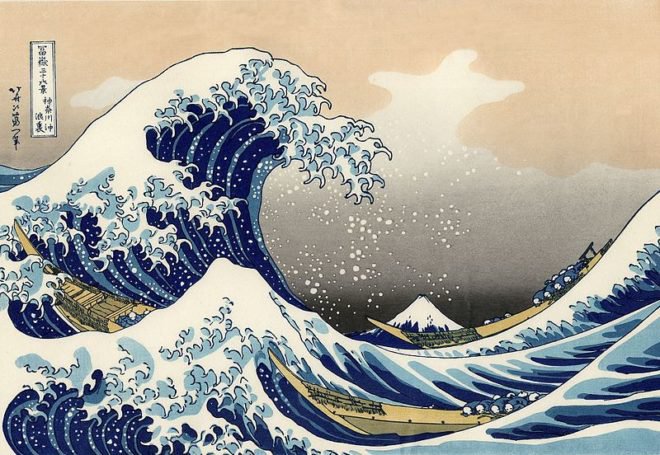
If the darkness below makes us uncomfortable, the water’s surface provides its own uncertainty. This week I watched a Great Art Explained video about The Great Wave off Kanagawa, by Japanese ukiyo-e artist Katsushika Hokusai. It’s a woodblock print that Hokusai made in 1831—part of his Thirty-six Views of Mount Fuji series.
The first thing you see in the famous image is the foreboding wave, suspended in midair and ready to crash. But a closer look reveals three fishing boats being tossed about on the tumultuous sea, along with a small Mount Fuji in the distance. The way in which the great wave overshadows Mount Fuji—a sacred symbol of Japanese resilience and strength—is significant. Hokusai intended it as a commentary on how Japan was becoming more open to western influences—a time of instability and uncertainty for the country that had firmly closed its doors to such influences for over two hundreds years. The sea that protects life in Japan also has the capacity to engulf it. The vivid “aliveness” of the wave itself is “the embodiment of Hokusai’s belief that Art has a life of its own—a life force.”
Certain things in life, like Art, have their own life force—things like Love and Grief. As much as we’ve advanced as humans, there’s still a lot that we don’t understand about these two related emotions—and about Grief, in particular. Grief remains as unexplored as the ocean, as chaotic as the waves crashing. It’s not until we’re plunged into its depths or tossed about by its waves that we truly come to know Grief.
In her book The Year of Magical Thinking, Joan Didion recounts the harrowing year following her husband’s sudden, unexpected death. She describes how Grief “comes in waves”:
Grief, when it comes, is nothing like we expect it to be. … Grief has no distance. Grief comes in waves, paroxysms, sudden apprehensions that weaken the knees and blind the eyes and obliterate the dailiness of life. Virtually everyone who has ever experienced grief mentions this phenomenon of ‘waves.’
Author Elizabeth Gilbert also compares Grief to a “wave”—or rather, a “tsunami”—while discussing the loss of her life’s partner in a TED interview. With raw insight, she explains how Grief is connected to Love through how we handle such waves when they hit:
I have learned that Grief is a force of energy that cannot be controlled or predicted. It comes and goes on its own schedule. Grief does not obey your plans, or your wishes. Grief will do whatever it wants to you, whenever it wants to. In that regard, Grief has a lot in common with Love.
The only way that I can ‘handle’ Grief, then, is the same way that I ‘handle’ Love—by not ‘handling’ it. By bowing down before its power, in complete humility.
When Grief comes to visit me, it’s like being visited by a tsunami. I am given just enough warning to say, ‘Oh my god, this is happening RIGHT NOW,’ and then I drop to the floor on my knees and let it rock me. How do you survive the tsunami of Grief? By being willing to experience it, without resistance.
Both Didion and Gilbert have faced realities of loss that seem unimaginable to those who have not gone through them. But psychotherapist and grief advocate Megan Devine cautions that a key problem with how our culture approaches grief isn’t an inability to imagine that kind of pain, but a fear of doing so—we can imagine it, but we don’t want to. Rather than face such tremendous pain alongside those going through it, we turn away from it. According to Devine, this results in us failing to connect with those in grief. Pain is a reality of being human. To ignore that potential for ourselves—or our loved ones who are experiencing it—is to deny what it means to be fully human. And for those treading in their darkest waters, it only adds to their suffering.
In Devine’s book It’s OK that You’re Not OK: Meeting Grief and Loss in a Culture that Doesn’t Understand, she writes that in honoring the full breadth of grief, we also honor the full breadth of love. Those depths are equally profound. Like Gilbert, Devine writes that both grief and love are mysteries before which we must bow down. She writes:
Grief no more needs a solution than love needs a solution. We cannot ‘triumph’ over death, or loss, or grief. They are immovable elements of being alive. If we continue to come at them as though they are problems to be solved, we’ll never get solace or comfort for our deepest pain.
Instead of treating grief as a problem to be fixed, Devine proposes that we simply allow it to exist. The only way to handle grief’s waves is to let them wash over you. Educator Parker Palmer says that “the human soul doesn’t want to be advised or fixed or saved. It simply wants to be witnessed, exactly as it is.” By acknowledging and bearing witness to the pain of those in grief—by swimming in the dark and wavy waters alongside them—we help them know that things can be made better, even though they can’t be made right. There’s no turning back, no jumping forward, and no skipping around. The only way out is through—with a willingness to let the waves move you as they will—as you find a way to live this new reality that has met you.
If you’re experiencing grief, or trying to support someone in grief, check out Megan Devine’s website Refuge in Grief. If you’re trying to help a loved one, her essay “How to Help a Grieving Friend: 11 Things to Do When You’re Not Sure What to Do” and infographic “Do This, Not That” are good places to start.