Tag: death

  • It Comes in Waves

    I like being in and around water. With its many lakes and rivers, my home state of Wisconsin provides ample opportunities to enjoy it. There aren’t any oceans, of course, but the expansive Lake Superior to the north and Lake Michigan to the east evoke the illusion of one. Standing on those shores, your gaze finds no land on the horizon, and the waters can swell into waves that are big enough to surf.

    But large bodies of water—like the Great Lakes and oceans of the world—are mysterious places for us land dwellers. The ocean, itself, covers about 70% of the Earth’s surface and despite its importance to life on this planet, there’s so much we still don’t know about it. As of 2024, only 26.1% of the ocean floor has been mapped using sonar technologies, and only 5% of the ocean has actually been explored.

    These deep waters conjure the unknown. One of my favorite lines from the Harry Potter books comes from Dumbledore, as he and Harry are crossing the dark waters of a sea cave to locate one of Voldemort’s Horcruxes:

    There is nothing to be feared from a body, Harry, any more than there is anything to be feared from the darkness. It is the unknown we fear when we look upon death and darkness, nothing more.

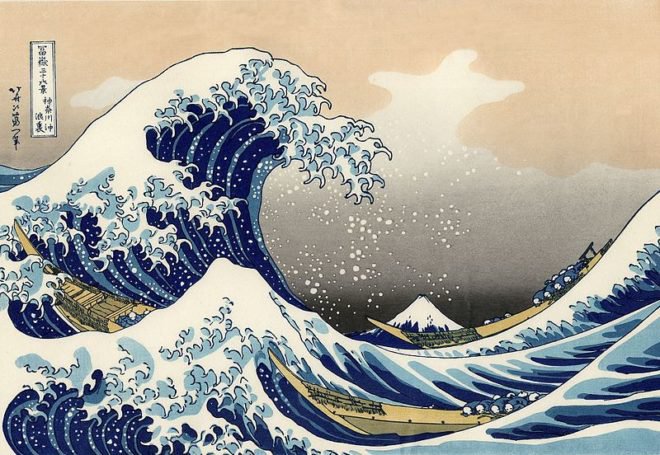
    If the darkness below makes us uncomfortable, the water’s surface provides its own uncertainty. This week I watched a Great Art Explained video about The Great Wave off Kanagawa, by Japanese ukiyo-e artist Katsushika Hokusai. It’s a woodblock print that Hokusai made in 1831—part of his Thirty-six Views of Mount Fuji series.

    The first thing you see in the famous image is the foreboding wave, suspended in midair and ready to crash. But a closer look reveals three fishing boats being tossed about on the tumultuous sea, along with a small Mount Fuji in the distance. The way in which the great wave overshadows Mount Fuji—a sacred symbol of Japanese resilience and strength—is significant. Hokusai intended it as a commentary on how Japan was becoming more open to western influences—a time of instability and uncertainty for the country that had firmly closed its doors to such influences for over two hundreds years. The sea that protects life in Japan also has the capacity to engulf it. The vivid “aliveness” of the wave itself is “the embodiment of Hokusai’s belief that Art has a life of its own—a life force.”

    Certain things in life, like Art, have their own life force—things like Love and Grief. As much as we’ve advanced as humans, there’s still a lot that we don’t understand about these two related emotions—and about Grief, in particular. Grief remains as unexplored as the ocean, as chaotic as the waves crashing. It’s not until we’re plunged into its depths or tossed about by its waves that we truly come to know Grief.

    In her book The Year of Magical Thinking, Joan Didion recounts the harrowing year following her husband’s sudden, unexpected death. She describes how Grief “comes in waves”:

    Grief, when it comes, is nothing like we expect it to be. … Grief has no distance. Grief comes in waves, paroxysms, sudden apprehensions that weaken the knees and blind the eyes and obliterate the dailiness of life. Virtually everyone who has ever experienced grief mentions this phenomenon of ‘waves.’

    Author Elizabeth Gilbert also compares Grief to a “wave”—or rather, a “tsunami”—while discussing the loss of her life’s partner in a TED interview. With raw insight, she explains how Grief is connected to Love through how we handle such waves when they hit:

    I have learned that Grief is a force of energy that cannot be controlled or predicted. It comes and goes on its own schedule. Grief does not obey your plans, or your wishes. Grief will do whatever it wants to you, whenever it wants to. In that regard, Grief has a lot in common with Love.

    The only way that I can ‘handle’ Grief, then, is the same way that I ‘handle’ Love—by not ‘handling’ it. By bowing down before its power, in complete humility.

    When Grief comes to visit me, it’s like being visited by a tsunami. I am given just enough warning to say, ‘Oh my god, this is happening RIGHT NOW,’ and then I drop to the floor on my knees and let it rock me. How do you survive the tsunami of Grief? By being willing to experience it, without resistance.

    Both Didion and Gilbert have faced realities of loss that seem unimaginable to those who have not gone through them. But psychotherapist and grief advocate Megan Devine cautions that a key problem with how our culture approaches grief isn’t an inability to imagine that kind of pain, but a fear of doing so—we can imagine it, but we don’t want to. Rather than face such tremendous pain alongside those going through it, we turn away from it. According to Devine, this results in us failing to connect with those in grief. Pain is a reality of being human. To ignore that potential for ourselves—or our loved ones who are experiencing it—is to deny what it means to be fully human. And for those treading in their darkest waters, it only adds to their suffering.

    In Devine’s book It’s OK that You’re Not OK: Meeting Grief and Loss in a Culture that Doesn’t Understand, she writes that in honoring the full breadth of grief, we also honor the full breadth of love. Those depths are equally profound. Like Gilbert, Devine writes that both grief and love are mysteries before which we must bow down. She writes:

    Grief no more needs a solution than love needs a solution. We cannot ‘triumph’ over death, or loss, or grief. They are immovable elements of being alive. If we continue to come at them as though they are problems to be solved, we’ll never get solace or comfort for our deepest pain.

    Instead of treating grief as a problem to be fixed, Devine proposes that we simply allow it to exist. The only way to handle grief’s waves is to let them wash over you. Educator Parker Palmer says that “the human soul doesn’t want to be advised or fixed or saved. It simply wants to be witnessed, exactly as it is.” By acknowledging and bearing witness to the pain of those in grief—by swimming in the dark and wavy waters alongside them—we help them know that things can be made better, even though they can’t be made right. There’s no turning back, no jumping forward, and no skipping around. The only way out is through—with a willingness to let the waves move you as they will—as you find a way to live this new reality that has met you.

    If you’re experiencing grief, or trying to support someone in grief, check out Megan Devine’s website Refuge in Grief. If you’re trying to help a loved one, her essay “How to Help a Grieving Friend: 11 Things to Do When You’re Not Sure What to Do” and infographic “Do This, Not That” are good places to start.

  • Home Is People

    My dear friend Matt Neely introduced me to David Berman in the fall of 2003. Matt and I attended grad school together and one day he lent me his CD of the album Bright Flight, by Berman’s band Silver Jews. Their current Spotify bio describes them as “a beautiful mess of indie rock, country-rock and lo-fi with lyrics both witty and profound.” After a few listens I was hooked. Beyond the scratchy guitar rifts and straightforward, yet often fractured folk-rock melodies, I really connected with Berman’s songwriting and shaky vocals. He was a lyricist who could turn a phrase like no other. His crackly deadpan delivery only added to his effectiveness as a storyteller.

    One of my favorite lyrics of Berman’s comes from his song “Time Will Break The World.” I repeat it to myself each year when winter grows long and I grow tired of yet another snowfall:

    The snow falls down so beautiful and stupid

    Couple this with Phil Connor’s prediction from Groundhog Day and you have perfectly summarized the late-winter, early-spring feels of Wisconsin.

    Berman struggled with depression and drug addiction throughout his life. Tragically, he died by suicide in August of 2019, just one month after having released his first new music in a decade, under the new moniker Purple Mountains. A close listen to the self-titled album reveals a version of David Berman who was still very much struggling with his demons.

    Purple Mountains (via Pitchfork)

    I had been planning on seeing Berman perform live for the first time later that summer. The news of his death shook me, as it did so many others. His impact was widespread, among fans and fellow musicians alike, and an outpouring of love and heartfelt condolence seemed to flow from every corner during the weeks to follow. In an article titled “David Berman Changed the Way So Many of Us See the World,” Mark Richardson writes:

    It feels important to note that his lyrics, which seemed to be beamed in from another dimension, were used in service of songs that were generally sturdy and sounded good wherever they were needed.

    Still, though, those words. Jazz critic Gary Giddins, writing about the work of Ornette Coleman, once noted ‘the music hits me in unprotected areas of the brain, areas that remain raw and impressionable,’ and Berman’s words functioned like that too. He had a gift for writing that, ironically, and in a very Berman-esque way, is hard to talk about. His use of language is so specific, it’s hard to find some of your own to describe it in a way that doesn’t diminish what you’re trying to convey. ‘The meaning of the world lies outside the world’ is how he put a related idea, in another context, in his song ‘People.’ But the way I’m describing it now makes it sound like something heady and tangled and complicated. It was the opposite. Berman had a knack for representing what was right in front of you in a way that made you see it as if for the first time.

    I find myself relating to Richardson’s words, as I try to find the right words, to describe David Berman’s words. You’re better off just accessing his music directly. Even if Berman’s suffering was clearly expressed through his songs, he conveyed it in a tone that was both warm and oftentimes comical. There was a therapeutic lightness toward life’s difficulties that he wove into the fabric of his songs. It was a quality that I think genuinely helped a lot of people.

    In another song touching on winter’s theme, “Snow Is Falling in Manhattan,” he writes the ghost of himself into the very song, allowing for visitors to gather round and warm themselves by the fire he creates:

    Songs build little rooms in time
    And housed within the song’s design
    Is the ghost the host has left behind
    To greet and sweep the guest inside
    Stoke the fire and sing his lines

    The song builds a room, presumably within a house, where the songwriter continues to live, and hosts whichever guest might appear with a need for warmth and companionship.

    Berman wrote a book of poetry called Actual Air, originally released in 1999, but reissued in 2019, also just weeks before his death. As is the case with his songs, Berman’s witty insights about life, in all its wonder and bleakness, can be found in this brilliant collection of poems.

    Actual Air, by David Berman

    One of my favorites is “The Homeowner’s Prayer.” It’s a poem that considers the circular and linear nature of time. We move through the stages of life on a path toward our imminent demise, as the seasons continue to circle back around, obscuring the fact that one day they no longer will, at least not for us. And the time they take to come around seems to get ever faster as we get older. This is a sad poem about a man’s untaken opportunities and unlived experiences that are eventually lost to him. They were never really his to begin with because he did not live them. Time, as it were, passed him by.

    But this poem reminds me that we ought to think of “home” as the people more so than the place. The title seemed incongruent to me at first, but maybe that is the prayer—let me value people above place. I have moved enough in my life to understand that my true home is the people I get to experience life with. Everything loses its flavor when you take away the people for whom you care about the most. We often confuse this simple truth in a modern society that confuses simple facts. What if, as a “homeowner,” the first thing that came to mind were the people who inhabit my heart, rather than the house I inhabit? Berman’s poem helps me to be mindful of the moments I get to spend with my people and to value the immaterial over the material.

    I think David Berman knew that home was more than a place. He saw his own songs as a home, not just for him to live in, but also for any guest who would enter them to listen. Here is the poem in its entirety:

    The Homeowner’s Prayer – by David Berman

    The moment held two facets in his mind.
    The sound of lawns cut late in the evening
    and the memory of a push-up regimen he had abandoned.

    It was Halloween.

    An alumni newsletter lay on the hall table
    but he would not/could not read it,
    for his hands were the same emotional structures
    in 1987 as they had been in 1942.

    Nothing had changed. He had retained his tendency
    to fall in love with supporting actresses
    renowned for their near miss with beauty

    and coffee still caused the toy ideas
    he used to try out on the morning carpools,
    a sweeping reorganization of the company softball leagues,
    or how to remove algae from the windows of a houseboat.

    He remembered a morning when the carpool
    had been discussing how they’d like to die.
    The best way to go.

    He said, why are you talking about this.
    Just because everyone has died so far,
    doesn’t mean that we’re going to die.

    But he had waited too long to speak.
    They were already in the parking garage.
    And now two of them had passed away.

    It was Halloween.

    Another Pennsylvania sunset
    backed down the local mountain

    spraying the colors of a streetfighter’s face
    onto the narrative wallpaper of a boy’s bedroom.

    Once he thought all he would ever need
    was a house with time and circumstance.

    He slowly made his way into the kitchen
    and filled a bowl with apples and raisins.

    The clock was learning to be 6:34.

    The willows bent to within decimals of the lawn.

    It was Halloween.

    The years go round and round. Halloween just passed and soon it will again. The 52 weeks that make up a year bring us back to this same spot pretty quickly. Add up a life’s worth and you only get 4,000 weeks, on average. How will you spend the time?

    “Time,” by David Shrigley (via Austin Kleon)

ABOUT THE AUTHOR

Eric Wenninger is an educator and writer. He teaches language and culture and writes about his thoughts and experiences here.