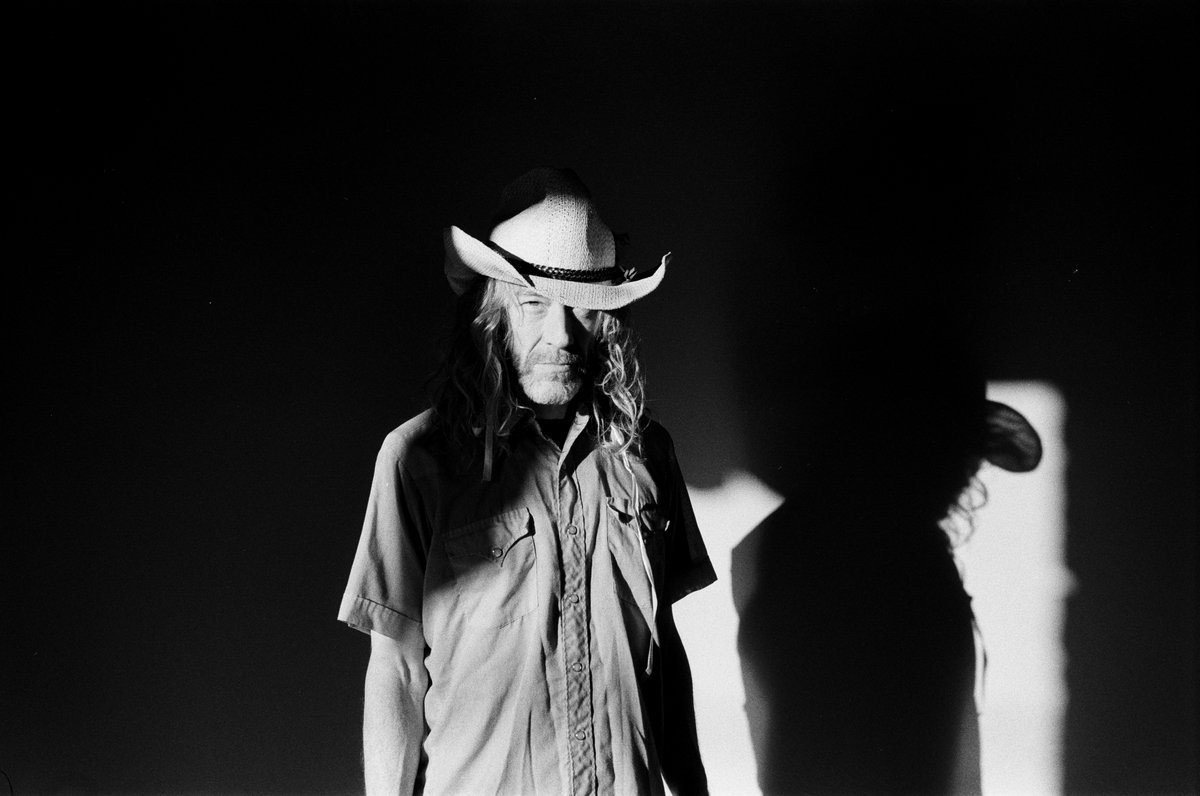
Earlier this spring, I was struck by the music video for Alan Sparhawk’s new single “Not Broken,” which features the Low band member contemplating life beside wavy waters. I wrote about it in last week’s newsletter on the waves of grief:
Alan Sparhawk of the band Low just released his second solo album—this time with accompaniment from the band Trampled by Turtles and appropriately titled With Trampled by Turtles. It’s a unique paring—Low’s music is part of the slowcore genre and Trampled by Turtles is known for their blisteringly fast bluegrass. Back in 2022, Sparhawk lost his wife and bandmate Mimi Parker to cancer. After Parker’s death, Trampled by Turtles invited Sparhawk to sit in with them on some of their shows. Both bands being from Duluth, it was an easy way they could show up for their longtime friend and support him during his grief. In this moving and insightful Stereogum interview, Sparhawk discusses his first solo album White Roses, My God—along with his experience grieving the loss of Parker. One of the singles from his new album is “Not Broken.” Its chorus features a female vocalist—sounding uncannily like Parker—who sings over and over again, “It’s not broken. I’m not angry.” This vocalist, it turns out, is the daughter of Sparhawk and Parker—Hollis. The music video for the song shows Sparhawk continuing to grieve Parker beside bleak, choppy waters—but with a hint that he’s finding his way into healing, that he and Hollis are not broken and not angry, despite their pain. As grief goes on, that’s a hopeful place to be.
You can check out the music video for “Not Broken” here:
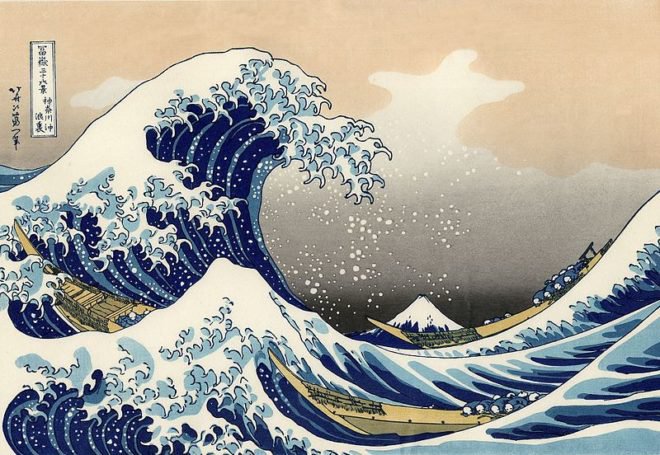
The Great Wave off Kanagawa, by Katsushika Hokusai – Image via Open Culture
I like being in and around water. With its many lakes and rivers, my home state of Wisconsin provides ample opportunities to enjoy it. There aren’t any oceans, of course, but the expansive Lake Superior to the north and Lake Michigan to the east evoke the illusion of one. Standing on those shores, your gaze finds no land on the horizon, and the waters can swell into waves that are big enough to surf.
These deep waters conjure the unknown. One of my favorite lines from the Harry Potter books comes from Dumbledore, as he and Harry are crossing the dark waters of a sea cave to locate one of Voldemort’s Horcruxes:
There is nothing to be feared from a body, Harry, any more than there is anything to be feared from the darkness. It is the unknown we fear when we look upon death and darkness, nothing more.
The first thing you see in the famous image is the foreboding wave, suspended in midair and ready to crash. But a closer look reveals three fishing boats being tossed about on the tumultuous sea, along with a small Mount Fuji in the distance. The way in which the great wave overshadows Mount Fuji—a sacred symbol of Japanese resilience and strength—is significant. Hokusai intended it as a commentary on how Japan was becoming more open to western influences—a time of instability and uncertainty for the country that had firmly closed its doors to such influences for over two hundreds years. The sea that protects life in Japan also has the capacity to engulf it. The vivid “aliveness” of the wave itself is “the embodiment of Hokusai’s belief that Art has a life of its own—a life force.”
Certain things in life, like Art, have their own life force—things like Love and Grief. As much as we’ve advanced as humans, there’s still a lot that we don’t understand about these two related emotions—and about Grief, in particular. Grief remains as unexplored as the ocean, as chaotic as the waves crashing. It’s not until we’re plunged into its depths or tossed about by its waves that we truly come to know Grief.
In her book The Year of Magical Thinking, Joan Didion recounts the harrowing year following her husband’s sudden, unexpected death. She describes how Grief “comes in waves”:
Grief, when it comes, is nothing like we expect it to be. … Grief has no distance. Grief comes in waves, paroxysms, sudden apprehensions that weaken the knees and blind the eyes and obliterate the dailiness of life. Virtually everyone who has ever experienced grief mentions this phenomenon of ‘waves.’
Author Elizabeth Gilbert also compares Grief to a “wave”—or rather, a “tsunami”—while discussing the loss of her life’s partner in a TED interview. With raw insight, she explains how Grief is connected to Love through how we handle such waves when they hit:
I have learned that Grief is a force of energy that cannot be controlled or predicted. It comes and goes on its own schedule. Grief does not obey your plans, or your wishes. Grief will do whatever it wants to you, whenever it wants to. In that regard, Grief has a lot in common with Love.
The only way that I can ‘handle’ Grief, then, is the same way that I ‘handle’ Love—by not ‘handling’ it. By bowing down before its power, in complete humility.
When Grief comes to visit me, it’s like being visited by a tsunami. I am given just enough warning to say, ‘Oh my god, this is happening RIGHT NOW,’ and then I drop to the floor on my knees and let it rock me. How do you survive the tsunami of Grief? By being willing to experience it, without resistance.
Both Didion and Gilbert have faced realities of loss that seem unimaginable to those who have not gone through them. But psychotherapist and grief advocate Megan Devine cautions that a key problem with how our culture approaches grief isn’t an inability to imagine that kind of pain, but a fear of doing so—we can imagine it, but we don’t want to. Rather than face such tremendous pain alongside those going through it, we turn away from it. According to Devine, this results in us failing to connect with those in grief. Pain is a reality of being human. To ignore that potential for ourselves—or our loved ones who are experiencing it—is to deny what it means to be fully human. And for those treading in their darkest waters, it only adds to their suffering.
Grief no more needs a solution than love needs a solution. We cannot ‘triumph’ over death, or loss, or grief. They are immovable elements of being alive. If we continue to come at them as though they are problems to be solved, we’ll never get solace or comfort for our deepest pain.
Instead of treating grief as a problem to be fixed, Devine proposes that we simply allow it to exist. The only way to handle grief’s waves is to let them wash over you. Educator Parker Palmer says that “the human soul doesn’t want to be advised or fixed or saved. It simply wants to be witnessed, exactly as it is.” By acknowledging and bearing witness to the pain of those in grief—by swimming in the dark and wavy waters alongside them—we help them know that things can be made better, even though they can’t be made right. There’s no turning back, no jumping forward, and no skipping around. The only way out is through—with a willingness to let the waves move you as they will—as you find a way to live this new reality that has met you.
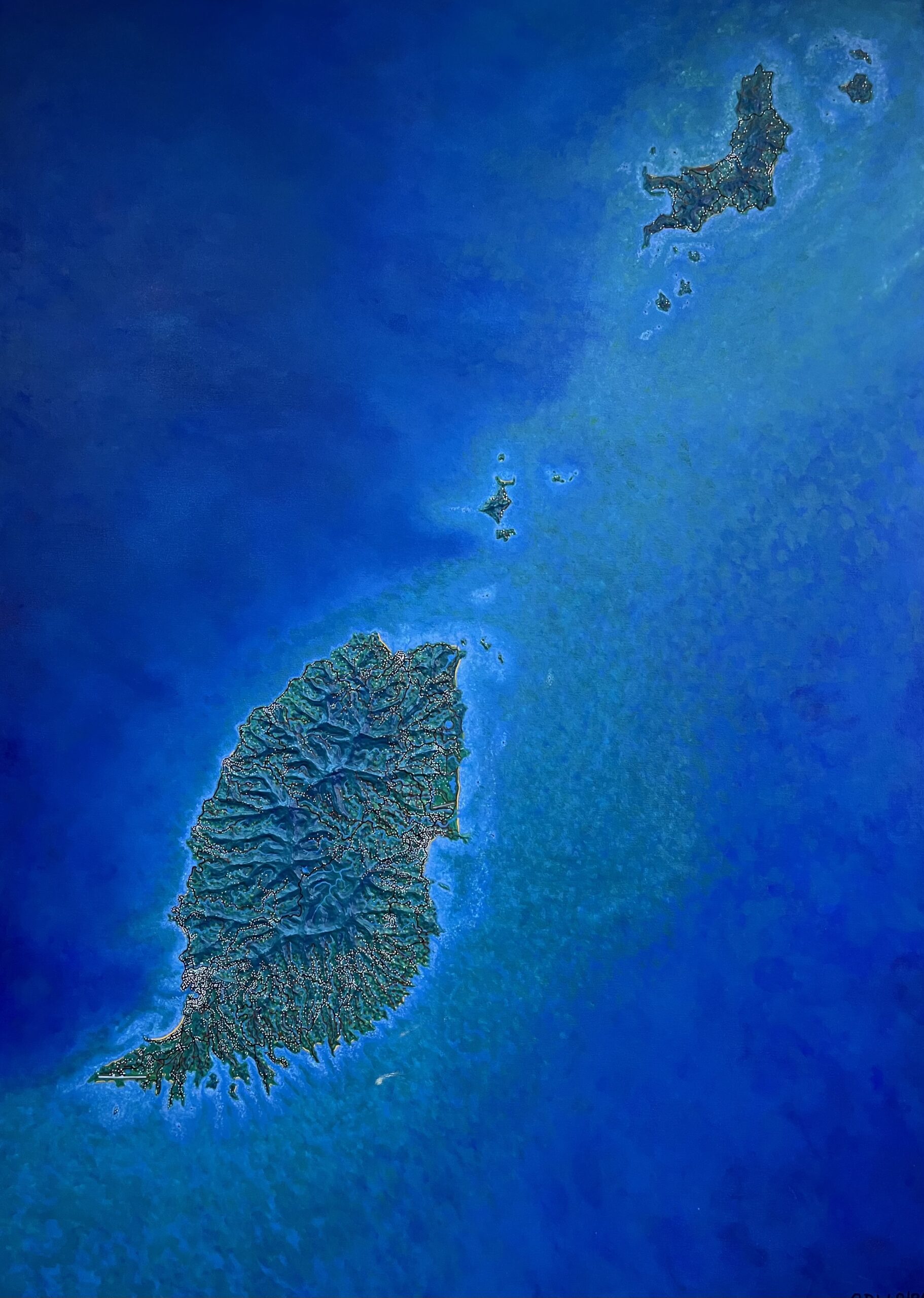
Painting of Grenada and its two smaller islands, Carriacou and Petite Martinique, to the north — a happy discovery while paying a campus parking ticket in the Chancellery building at SGU
Fall is my favorite time of year. As the days get shorter, the nights get cooler, inviting you to put on something cozy and warm before gathering round a campfire with friends. By the time October rolls around, football season is well underway, as are the yellows and reds scattered amongst the once-green leaves of the Northwoods. To me, fall is comfort. I love how it leads into the holiday seasons of Halloween, Thanksgiving, and Christmas—joyous times that each conjure their own moods of nostalgia mixed with anticipation.
I’ve always been grateful to live in a place that has four seasons. While living outside of any one season, you gain a fresh perspective of all the wondrous elements that season holds and look forward to the moment it will arrive again. It’s a constant cycle of welcoming back something that’s both novel and completely familiar at the same time.
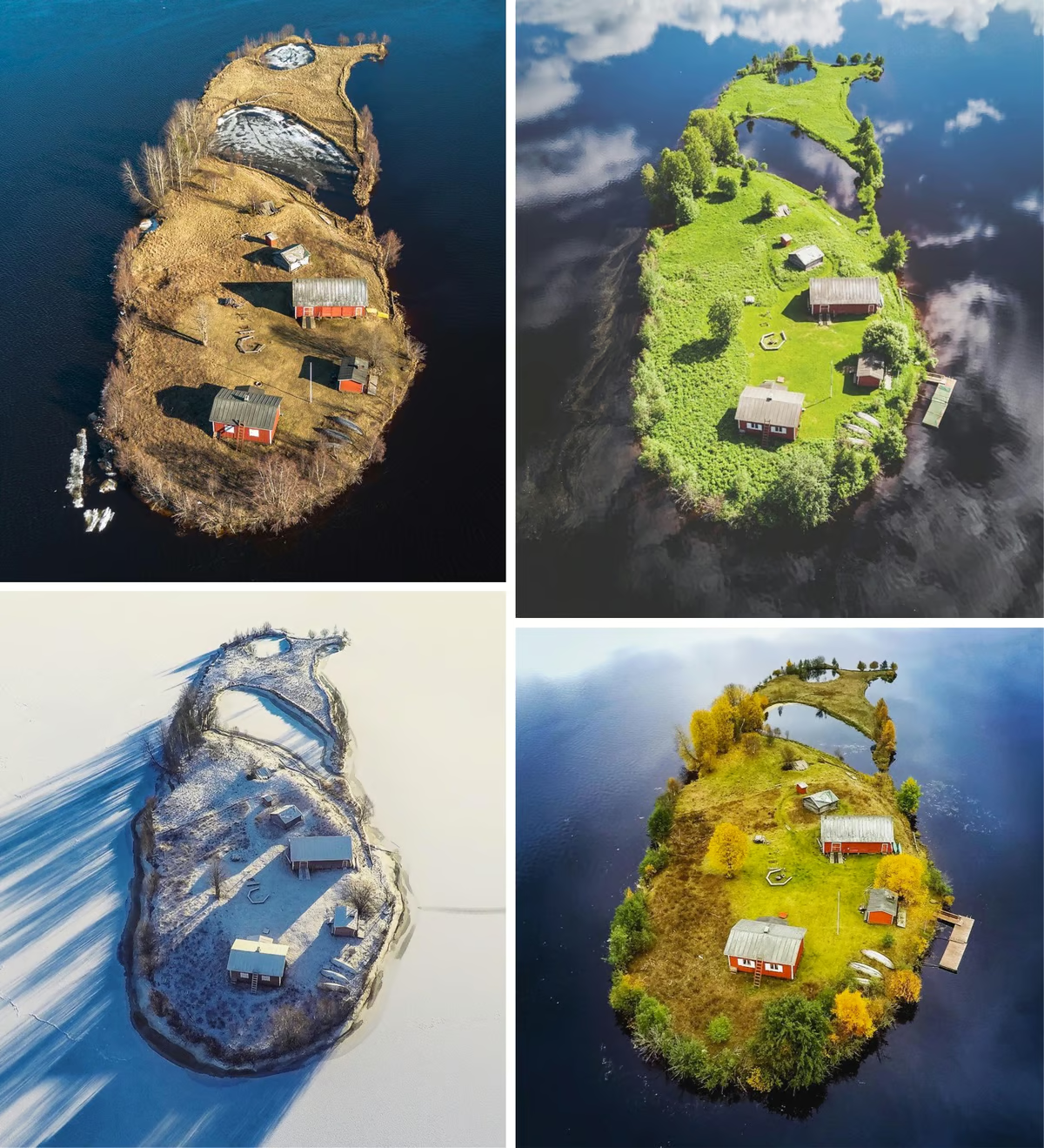
The following image from kottke.org struck me in its representation of how seasons bring change to one, isolated place, in this case a Finnish island, which is surprisingly shaped similar to Grenada.
Four seasons in the life of a Finnish island (via kottke.org)
Living abroad brings with it a strange juxtaposition of missing where you’re from while embracing where you are. I’ve been missing fall in the Midwest and all its delights, the changing of the color of leaves among them. In Grenada, there’s a rainy season and a dry season. We’re currently in the rainy season, which ends in late November. Other than scattered showers, I’ve started to wonder, “What aspects of Grenada should I be embracing while it’s my time to be here?”
This was on my mind one morning when I picked up Rick Rubin’s, The Creative Act: A Way of Being. I’ve been reading it every morning as a kind of devotional. The chapters are short and accessible, and offer a wealth of practical wisdom on cultivating creativity in your life—a perfect way to start the day. In a chapter on nature as teacher, Rubin brings up the seasons and other ways nature changes. He writes:
Nature is the most absolute and enduring. We can witness it change through the seasons. We can see it in the mountains, the oceans, the deserts, and the forest. We can watch the changes of the moon each night, and the relationship between the moon and the stars.
He goes on to talk about the wide range of color available to us in nature:
If you step out in nature, the palette is infinite. Each rock has such a variation of color within it, we could never find a can of paint to mimic the exact same shade.
Reading this really primed me (no pun intended) to intentionally embrace all of the new colors around me. As is the case with most things in life, when you catch onto an idea, other connections to that idea seem to pop up everywhere you look. Shortly after reading Rubin’s description of nature’s infinite color palette, I stumbled upon the following video from thurstonphoto.
The wave crashing beautifully in slow motion reveals a wide spectrum of blues and greens, a nuance that might go unnoticed in real time or casually missed by the unattuned eye. Anyone who comes to Grenada can see that the ocean surrounding it is made up of a vast array of blues and greens. I started to wonder if I might pull some meaning from them in the same way I would while reflecting on the reds and yellows of my home during this time of year.
Looking out over the Caribbean Sea from the campus of St. George’s University
So this October I’m contemplating blue. In his book, Theory of Colours (via The Marginalian), Johann Wolfgang von Goethe writes:
We love to contemplate blue — not because it advances to us, but because it draws us after it.
I relate to being drawn into a thing. Strangely, I think we are drawn into gazing out at the immensity of the ocean in a way that’s similar to how we are drawn into staring at the intimacy of a fire’s flame—one large and one small, yet both inspiring a sense of awe. Considering the connection here to the fall (warmth of a fire), I was motivated to dig (or swim?) further.
I discovered Rebecca Solnit’s book, A Field Guide to Getting Lost, via The Marginalian, and am currently working my way through it. In her book, Solnit contemplates the color blue. She starts by providing a scientific basis for why we see different shades of blue in nature and goes on to describe blue as the color of desire and longing. She writes:
The world is blue at its edges and in its depths. This blue is the light that got lost. Light at the blue end of the spectrum does not travel the whole distance from the sun to us. It disperses among the molecules of the air, it scatters in water. Water is colorless, shallow water appears to be the color of whatever lies underneath it, but deep water is full of this scattered light, the purer the water the deeper the blue. The sky is blue for the same reason, but the blue at the horizon, the blue of land that seems to be dissolving into the sky, is a deeper, dreamier, melancholy blue, the blue at the farthest reaches of the places where you see for miles, the blue of distance. This light that does not touch us, does not travel the whole distance, the light that gets lost, gives us the beauty of the world, so much of which is in the color blue.
For many years, I have been moved by the blue at the far edge of what can be seen, that color of horizons, of remote mountain ranges, of anything far away. The color of that distance is the color of an emotion, the color of solitude and of desire, the color of there seen from here, the color of where you are not. And the color of where you can never go. For the blue is not in the place those miles away at the horizon, but in the atmospheric distance between you and the mountains. “Longing,” says the poet Robert Hass, “because desire is full of endless distances.” Blue is the color of longing for the distances you never arrive in, for the blue world.
I found this so applicable to my current feelings of wanting to embrace Grenada while at the same time missing home. Solnit goes on to caution against fulfilling our desires through closing the great distance embodied by the blue of the ocean, in an attempt to grab hold of that which we seek. She writes:
We treat desire as a problem to be solved, address what desire is for and focus on that something and how to acquire it rather than on the nature and the sensation of desire, though often it is the distance between us and the object of desire that fills the space in between with the blue of longing. I wonder sometimes whether with a slight adjustment of perspective it could be cherished as a sensation on its own terms, since it is as inherent to the human condition as blue is to distance? If you can look across the distance without wanting to close it up, if you can own your longing in the same way that you own the beauty of that blue that can never be possessed? For something of this longing will, like the blue of distance, only be relocated, not assuaged, by acquisition and arrival, just as the mountains cease to be blue when you arrive among them and the blue instead tints the next beyond […] Something is always far away.
The idea of owning your “longing in the same way that you own the beauty of that blue that can never be possessed,” speaks an overwhelming truth to my soul. There is such empowerment to be found in accepting whatever uncontrolled adversity you face, and embracing those aspects of life that are within your ability to control. A shift of perspective is often all it takes. As humans, we are always longing for something, whether it be within our control or beyond it. What if we made peace with this fact and were contented to live in harmony alongside that longing instead? She concludes:
The blue of distance comes with time, with the discovery of melancholy, of loss, the texture of longing, of the complexity of the terrain we traverse, and with the years of travel. If sorrow and beauty are all tied up together, then perhaps maturity brings with it not … abstraction, but an aesthetic sense that partially redeems the losses time brings and finds beauty in the faraway. […] Some things we have only as long as they remain lost, some things are not lost only so long as they are distant.
It is indeed a complex terrain we traverse, filled with surprising contradictions.
Various shades of ocean blue I’ve found in Grenada
I see shades of blue all around me here. The ocean is reminding me of all the beauty to be found in this place just as it reminds me of how much I long for home.
Yet, if the blue of the ocean represents a great distance between me and home, I think it also provides a connection. Wisconsin is no stranger to expansive bodies of water after all. As I sit on a beach on the southern shores of Grenada, I know that two buddies of mine may very well be sitting on the northern shores of Wisconsin. I’m content to think about them, along with many others, while I welcome new waves upon my shore.
My buddy Joe J’s tattoo, revealing the blue and green shades of Lake Superior
As a final note, I love the music of fall. For the past couple of years I’ve put together a new Halloween mix each October. The Charlie Brown holiday specials are also some of my favorites, and I love the mood that the Vince Guarldi Trio brings to each season. So in honor of where I come from and where I am, I put together an October Oceans playlist. I intentionally made it to blend together the blues and greens of the Caribbean with the reds and yellows of the Midwest. You can listen to it here.
ABOUT THE AUTHOR
Eric Wenninger is an educator and writer. He teaches language and culture and writes about his thoughts and experiences here.